Who Was Caleb?
Caleb was an Israelite leader from the tribe of Judah, the son of Jephunneh, who lived during the wilderness years after the exodus from Egypt and into the conquest of Canaan. He is best known as one of the twelve spies Moses sent to scout the Promised Land — and one of only two who came back believing God would give Israel the victory. Scripture singles him out with a phrase it uses of almost no one else: he "wholly followed the LORD" (Numbers 14:24).
Where Caleb Appears in the Bible
Caleb shows up in four main places. He is introduced in Numbers 13–14, where he represents Judah among the twelve spies and stands against the majority report. He appears again in Deuteronomy 1:36, where Moses recalls God's promise that Caleb alone of his generation would enter the land. In Joshua 14, the elderly Caleb asks Joshua for the hill country of Hebron as his inheritance. And in Joshua 15 and Judges 1, the narrative records Caleb driving out the Anakim and giving his daughter Achsah in marriage to Othniel, who becomes Israel's first judge.
Caleb's Defining Moment
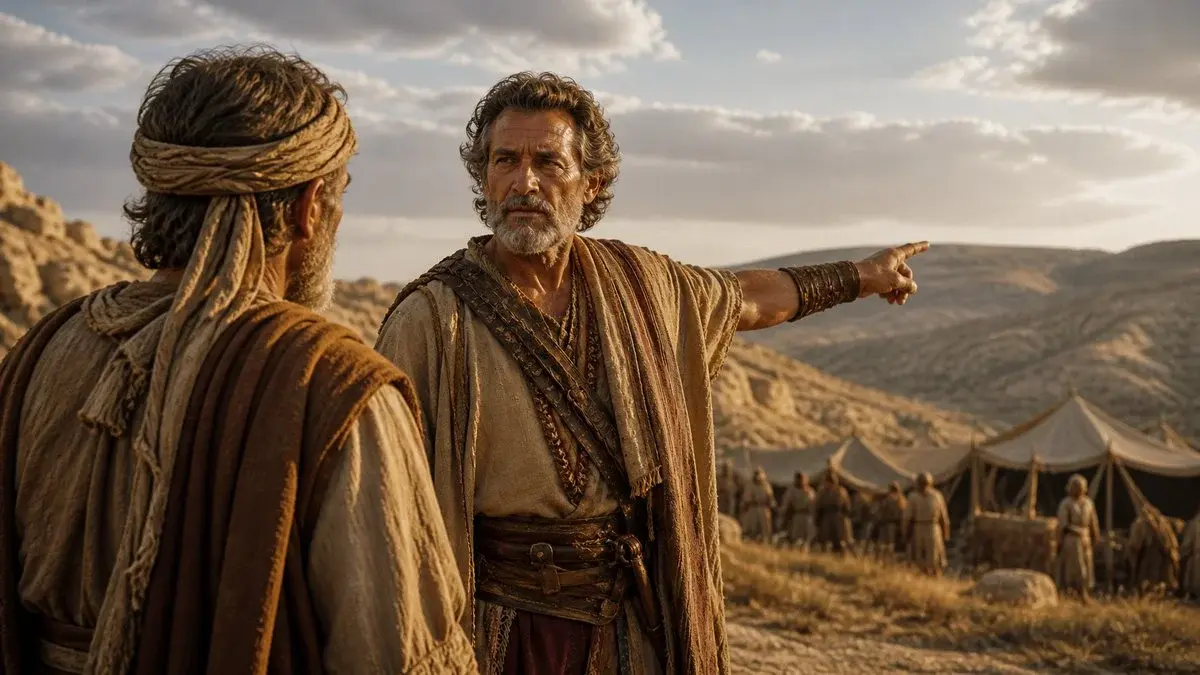
The twelve spies returned from Canaan carrying grapes so large a man had to bear them on a pole between two. Ten of them delivered a report that made the people's hearts melt: the cities were walled, the people were giants, and Israel looked like grasshoppers beside them. Caleb quieted the crowd and said, "Let us go up at once, and possess it; for we are well able to overcome it" (Numbers 13:30). When the ten pushed back harder, he and Joshua tore their clothes and insisted the land was exceedingly good and that the LORD would bring them in. The congregation responded by reaching for stones to kill them.
God's verdict on that generation was forty years of wandering until every adult who had doubted died in the wilderness — with two exceptions. "But my servant Caleb," God said, "because he had another spirit with him, and hath followed me fully, him will I bring into the land whereinto he went; and his seed shall possess it" (Numbers 14:24).
Forty-five years later, Caleb stood before Joshua and asked for the very region the ten spies had feared — Hebron, the hill country of the Anakim. At eighty-five he said, "As yet I am as strong this day as I was in the day that Moses sent me" (Joshua 14:11), and he drove out the giants and took the land.
Why Caleb Matters
Caleb is Scripture's great example of wholehearted trust that outlasts a crowd. Ten men saw the same grapes and the same walls and concluded God was too small; Caleb saw the same things and concluded the obstacles were bread to be eaten. His story is told in Numbers 13–14.
His faithfulness had consequences far beyond himself. Because he followed God fully, his family inherited Hebron, and his daughter's husband Othniel became the first judge who delivered Israel (Judges 3:9–11). Caleb's name even echoes through the generations: the genealogies of 1 Chronicles 2:18–19 and 4:15 trace his line, and the phrase "wholly followed the LORD" became the Bible's shorthand for him.
The church still talks about Caleb because his life answers a question every generation faces — whether to trust God's promise when the majority report says it is impossible. He is remembered not for extraordinary strength but for a heart that stayed loyal for forty-five years of waiting and then asked for the mountain.
