Who Was Mary Magdalene?
Mary Magdalene was a Jewish woman from the town of Magdala on the western shore of the Sea of Galilee, and one of Jesus' most faithful followers during his public ministry. Scripture identifies her as a woman from whom Jesus cast out seven demons, and she became part of the circle of women who supported and traveled with him. She is remembered above all as the first witness of the resurrection, a detail the Gospel writers record with striking consistency.
Where Mary Magdalene Appears in the Bible
She appears in all four Gospels, though never in the Old Testament. Luke introduces her in Luke 8:1-3, listing her among the women who provided for Jesus out of their own means. She stands among the women at the crucifixion in Matthew 27, Mark 15, and John 19, and she is present at the burial. All four Gospels place her at the empty tomb on resurrection morning (Matthew 28, Mark 16, Luke 24, John 20), and John gives her the longest scene, including her conversation with the risen Jesus in the garden.
Mary Magdalene's Defining Moment
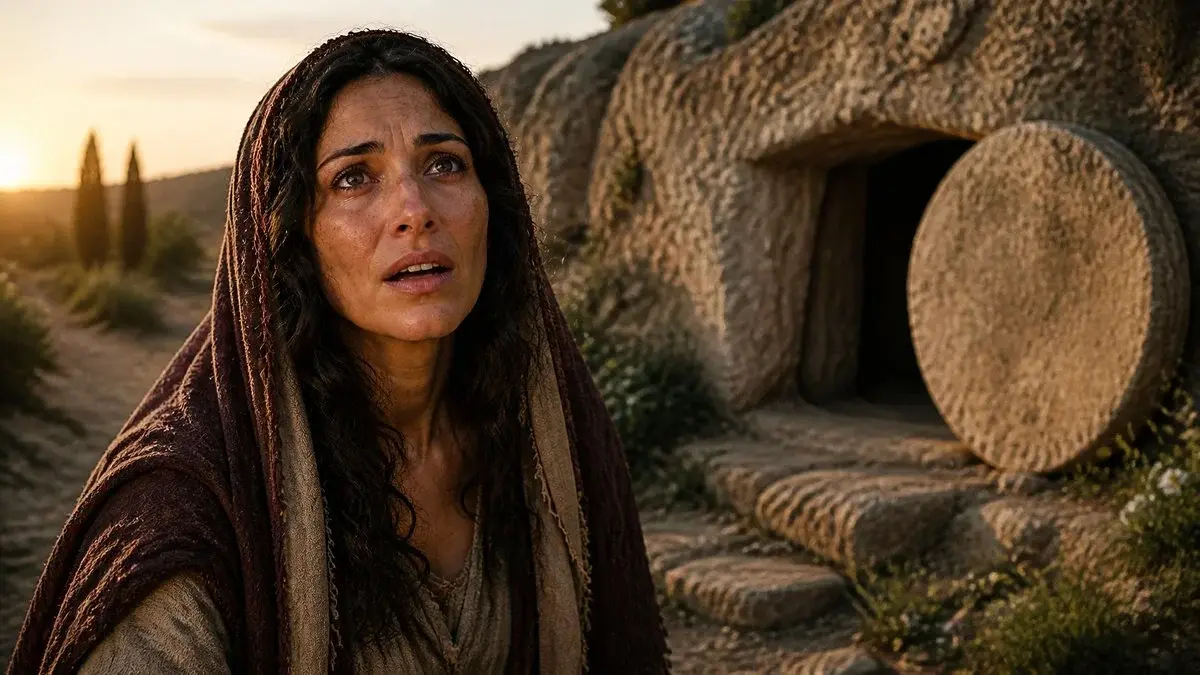
Her defining moment comes in John 20. While the other disciples returned home after finding the tomb empty, Mary stayed outside weeping. She peered into the tomb, saw two angels, and then turned to see a man she took for the gardener. When he asked why she was weeping, she answered, "Sir, if thou have borne him hence, tell me where thou hast laid him, and I will take him away" (John 20:15, KJV). Then the man spoke her name: "Mary." She recognized him and cried out, "Rabboni; which is to say, Master" (John 20:16, KJV).
What makes the scene so significant is that this woman, once tormented by seven demons and grieving at the cross, became the first person to see the resurrected Christ and the first to carry the news of Easter to the disciples. The Gospels do not soften her grief or her confusion; they let her stand there, weeping, until Jesus himself turns her sorrow into witness.
Why Mary Magdalene Matters
Mary Magdalene matters because her story is a story of transformation and stubborn devotion. Luke's brief note that seven demons had gone out of her tells us she knew firsthand what rescue looked like, and her response was to follow Jesus and help fund his ministry. She stayed near the cross when many fled, watched where his body was laid, and came to the tomb while it was still dark.
She is also the hinge of the resurrection accounts. Each Gospel names her among the first witnesses, and John gives her the first encounter with the risen Lord. That she was entrusted with the message "go to my brethren" (John 20:17, KJV) has made her, in the church's memory, the apostle to the apostles. Christians still talk about her because she embodies what the gospel claims: that Jesus lifts the broken, draws the devoted, and calls ordinary witnesses to announce that he is alive.
