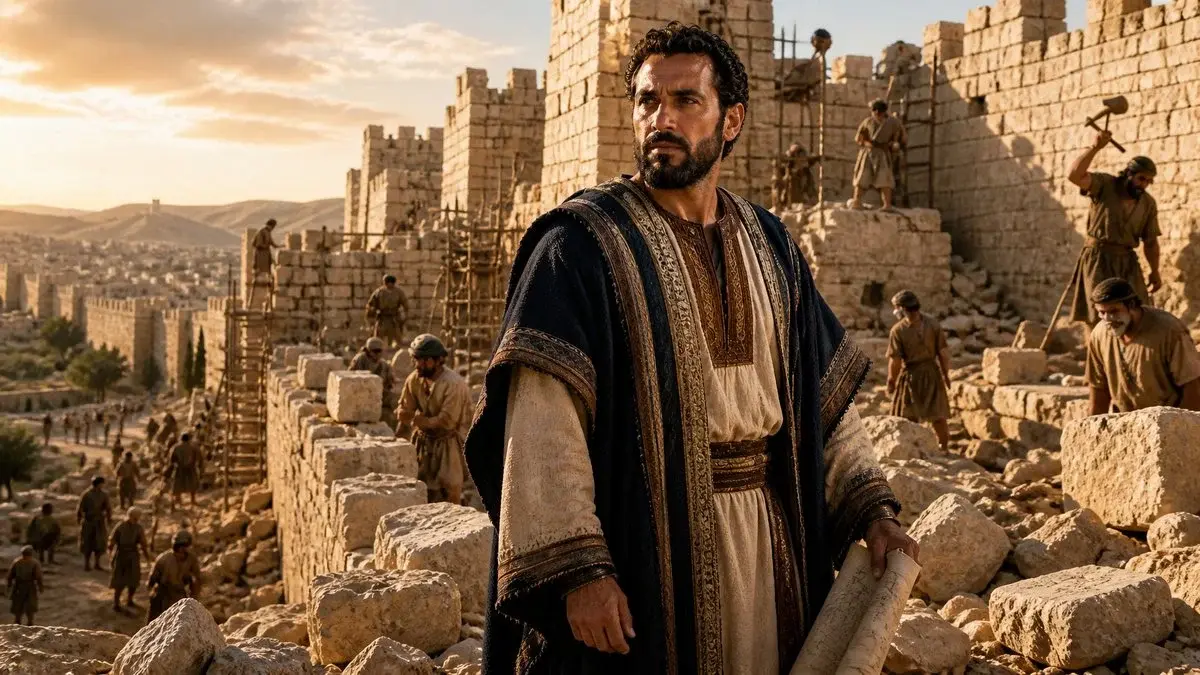
Who Was Nehemiah?
Nehemiah was a Jewish exile serving as cupbearer to Artaxerxes I, king of Persia, in the fifth century B.C. His father was Hacaliah, and Nehemiah belonged to the tribe of Judah, though he had spent his whole life in the Persian capital of Susa rather than the land of his ancestors. A cupbearer was no minor servant — he tasted the king's wine and stood close enough to the throne to be trusted with the ruler's life. That position of access became the hinge on which the whole story turns.
Where Nehemiah Appears in the Bible
Nehemiah appears in the book that bears his name, and essentially nowhere else. The book of Nehemiah (originally joined with Ezra in the Hebrew tradition) is largely written in his own voice — a first-person memoir of prayer, planning, and building. The key chapters are Nehemiah 1–2 (his grief, prayer, and request to the king), Nehemiah 3 (the wall-building roster), Nehemiah 4 (opposition and armed vigilance), Nehemiah 6 (the wall completed), and Nehemiah 8–9 (the people gathered to hear the Law read aloud). The entire arc runs from chapter 1 through chapter 13.
Nehemiah's Defining Moment
When messengers arrived from Jerusalem, Nehemiah asked about the city and learned that the wall was broken down and its gates burned with fire. He sat and wept, then fasted and prayed for days, confessing sin and appealing to God's promises. Months later, the king noticed his sadness and asked what was wrong. Nehemiah prayed a quick prayer, then asked boldly: "If it please the king, and if thy servant have found favour in thy sight, that thou wouldest send me unto Judah, unto the city of my fathers' sepulchres, that I may build it" (Nehemiah 2:5).
He arrived in Jerusalem, surveyed the ruins by night so no one would know his plans, and then told the officials: "Come, and let us build up the wall of Jerusalem, that we be no more a reproach" (Nehemiah 2:17). The people answered, "Let us rise up and build." Opposition came fast — Sanballat and Tobiah mocked and threatened — but Nehemiah organized the work by family and district, posted guards, and kept tools in one hand and weapons in the other. The wall was finished in fifty-two days, and even their enemies recognized the work had been done with God's help (Nehemiah 6:15–16).
Why Nehemiah Matters
Nehemiah is remembered as the rebuilder of Jerusalem's walls and, just as importantly, as a leader who paired prayer with planning. His memoir shows a man who wept over ruins but also drafted budgets, inspected rubble, assigned work, and refused to be intimidated. Beyond the wall, he partnered with Ezra in the spiritual renewal of the returned exiles, gathering the people to hear the Law read and renew their covenant. The church still talks about him because his story holds together vision and persistence: a clear-eyed look at what is broken, a prayerful appeal to God, and the stubborn, unglamorous work of rebuilding one section at a time. His famous line, "the God of heaven, he will prosper us" (Nehemiah 2:20), remains a model of confidence rooted in obedience rather than optimism.
