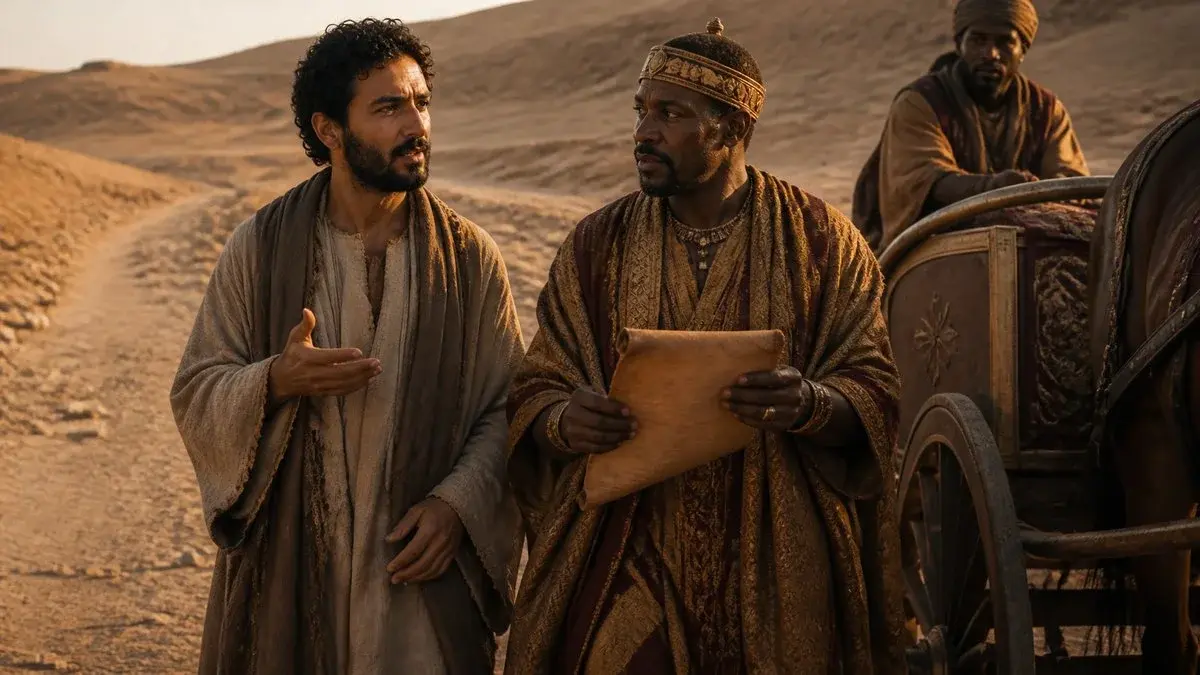
Who Was Philip?
Philip, often called Philip the Evangelist, was a prominent early Christian leader in the first-century church. He was one of the seven men chosen by the apostles to oversee the daily distribution of food to widows in Jerusalem (Acts 6:1-6). Though often confused with Philip the Apostle, this Philip was not one of the original twelve disciples. He was a Hellenistic Jew, likely from the diaspora, and his Greek name suggests a connection to the wider Greco-Roman world. The Bible doesn't name his family, but he had four unmarried daughters who prophesied (Acts 21:8-9), showing a deeply spiritual household.
Where Philip Appears in the Bible
Philip is found in the Acts of the Apostles. He appears in Acts 6:5 as one of the seven deacons. His major story unfolds in Acts 8, where he preaches in Samaria and encounters the Ethiopian eunuch. Later, in Acts 21:8-9, he is mentioned as a host for Paul in Caesarea. These are the only passages where he appears.
Philip's Defining Moment
Philip's defining moment is his encounter with an Ethiopian official on the road to Gaza, as recorded in Acts 8:26-40. An angel directed Philip to go to that desert road. There he saw a chariot carrying a high-ranking official from Ethiopia, the treasurer of Queen Candace. The man was reading aloud from the prophet Isaiah. Philip, prompted by the Spirit, ran up to him and asked, "Understandest thou what thou readest?" (Acts 8:30). The eunuch invited Philip to join him, and Philip explained that the passage (Isaiah 53:7-8) was about Jesus. As they traveled, they came to some water, and the eunuch said, "See, here is water; what doth hinder me to be baptized?" (Acts 8:36). Philip baptized him on the spot, and the Spirit then snatched Philip away to Azotus, leaving the eunuch to continue his journey rejoicing. This moment shows Philip's perfect obedience to the Spirit's leading, his willingness to cross cultural barriers (Jews avoided eunuchs and Gentiles), and his immediate focus on sharing the good news of Jesus.
Why Philip Matters
Philip matters because he exemplifies the Spirit-empowered expansion of the early church beyond its Jewish roots. His preaching in Samaria (Acts 8:5-8) brought joy to a people traditionally despised by Jews, fulfilling Jesus' command to be witnesses in Samaria (Acts 1:8). His encounter with the Ethiopian, a Gentile and a eunuch, prefigured the gospel's reach to all nations, as seen in the Great Commission. Philip's story demonstrates that ordinary believers, not just apostles, were used by God to perform miracles and lead others to faith. He also shows the importance of listening to God's voice, even when it leads to unexpected places. Today, the church remembers Philip as a model of evangelism and obedience, a reminder that the Spirit still calls people to cross barriers and share the good news.
For the full story, read Acts 8.
