Who Was Silas?
Silas, also known as Silvanus, was a leading member of the early Christian church in Jerusalem and a prophet (Acts 15:22, 32). He became a trusted companion of the Apostle Paul, traveling with him on his second missionary journey. He lived in the first century AD and played a crucial role in establishing and strengthening churches across Asia Minor and Greece. Silas was a Roman citizen, which gave him certain legal protections, and he was known for his steadfast faith and encouragement.
Where Silas Appears in the Bible
Silas appears primarily in the Acts of the Apostles and in the New Testament letters. He is introduced in Acts 15, where he is chosen to deliver the council's letter to Gentile believers in Antioch. He then accompanies Paul on his second missionary journey (Acts 15:40–18:5). He is also mentioned in 2 Corinthians 1:19, 1 Thessalonians 1:1, 2 Thessalonians 1:1, and 1 Peter 5:12, where he is described as a faithful brother. His most dramatic scene is in Acts 16, where he and Paul are imprisoned in Philippi.
Silas's Defining Moment
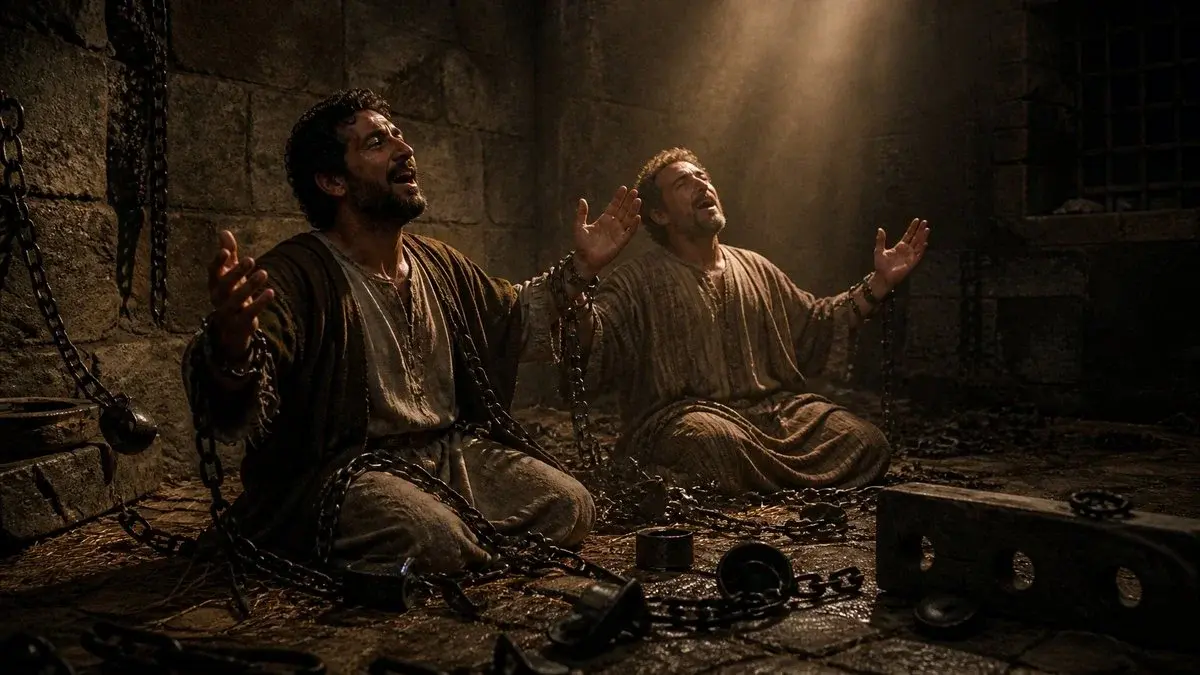
Silas's defining moment occurred in Philippi, a Roman colony. After Paul cast a spirit of divination out of a slave girl, her owners, enraged at their lost income, dragged Paul and Silas before the magistrates. They were stripped, beaten with rods, and thrown into the inner prison with their feet fastened in stocks (Acts 16:23-24).
Instead of despairing, at midnight Paul and Silas were praying and singing hymns unto God, and the prisoners heard them (Acts 16:25). Suddenly, a great earthquake shook the prison's foundations, opening all the doors and loosing everyone's bands. When the jailer awoke and saw the doors open, he drew his sword to kill himself, believing the prisoners had fled. But Paul cried out, "Do thyself no harm: for we are all here" (Acts 16:28). The jailer, trembling, asked, "Sirs, what must I do to be saved?" They replied, "Believe on the Lord Jesus Christ, and thou shalt be saved, and thy house" (Acts 16:31). That very night, the jailer washed their wounds and was baptized, rejoicing in God.
This event showcases Silas's unwavering faith and courage. His worship in chains not only led to his miraculous release but also to the salvation of the jailer and his entire household.
Why Silas Matters
Silas matters because he exemplifies faithful partnership in the gospel. He was a prophet and a teacher, a man who encouraged and strengthened the early believers (Acts 15:32). He endured persecution and suffering alongside Paul, yet his worship in prison became a powerful testimony. His actions demonstrate that praise can break chains and open hearts. The church still remembers Silas as a model of resilient faith, a bridge between Jewish and Gentile Christians, and a co-laborer who helped shape the early Christian movement. His story encourages believers to trust God even in the darkest circumstances.
Read the full account of Silas in Acts 16.
