Who Was Stephen?
Stephen was one of the seven men chosen by the apostles to serve the early church in Jerusalem, often considered the first deacons. He was a Hellenistic Jew, meaning he was a Greek-speaking Jew from the Diaspora, and he was known for his wisdom and being full of the Holy Spirit. He lived in the first century AD, shortly after the resurrection and ascension of Jesus Christ.
Where Stephen Appears in the Bible
Stephen's story is told exclusively in the Book of Acts, specifically in chapters 6 and 7. He is introduced in Acts 6:5 as one of the seven chosen to oversee the daily distribution to widows, and his martyrdom is recorded in Acts 7:54-60. His speech before the Sanhedrin, the longest recorded in Acts, spans Acts 7:1-53.
Stephen's Defining Moment
Stephen's defining moment is his bold defense of the faith before the Sanhedrin and his subsequent martyrdom. Accused of blasphemy by members of the synagogue of the Freedmen, Stephen was brought before the council. There, his face shone like an angel (Acts 6:15). He delivered a powerful sermon recounting Israel's history, demonstrating how the people had always resisted the Holy Spirit, and concluded by accusing them of betraying and murdering the Righteous One, Jesus (Acts 7:51-52).
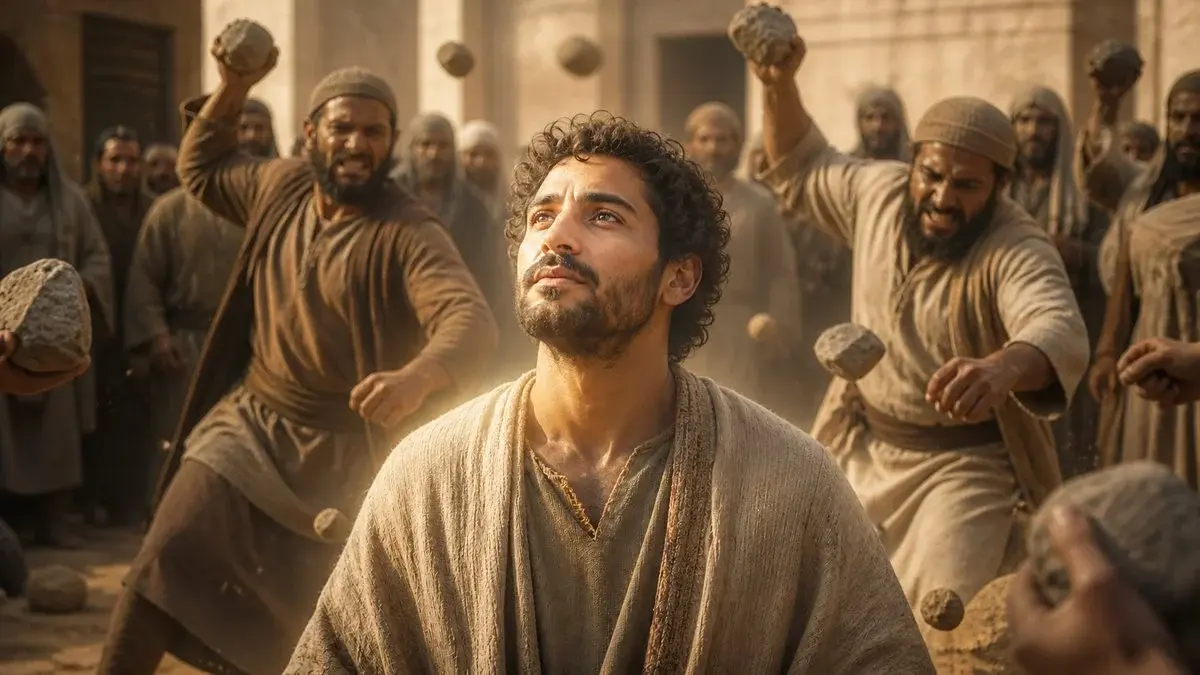
Enraged, the crowd gnashed their teeth at him. But Stephen, full of the Holy Spirit, gazed into heaven and saw the glory of God, and Jesus standing at the right hand of God. He declared, "Behold, I see the heavens opened, and the Son of man standing on the right hand of God" (Acts 7:56, KJV). At this, they cried out, stopped their ears, and rushed at him, casting him out of the city and stoning him. As the stones struck him, Stephen prayed, "Lord Jesus, receive my spirit" (Acts 7:59, KJV). Then he knelt and cried with a loud voice, "Lord, lay not this sin to their charge" (Acts 7:60, KJV). With those words, he fell asleep in death, becoming the first Christian martyr.
Why Stephen Matters
Stephen is remembered as the first martyr of the Christian church, a man whose bold witness and forgiving spirit mirrored that of Jesus Himself. His martyrdom marked a turning point in the early church, leading to intensified persecution that scattered believers and spread the gospel beyond Jerusalem (Acts 8:1). Among those who witnessed his death was a young man named Saul, who would later become the apostle Paul. Stephen's example of faith, courage, and forgiveness continues to inspire Christians facing opposition. His story is a powerful reminder of the cost of discipleship and the victory of a life fully surrendered to God. The church still talks about Stephen because he shows what it looks like to follow Jesus even unto death, trusting in the promise of eternal life.
